
Title: Simmons Sunset
Digital Art
NWJ
Art
Art by Norman Johnson
Explore St. Augustine, Florida
Fine Art for Home and Office
Florida Cities
Pictures of historical buildings, houses and environments around the state of Florida and some information about them. Browse the images below.

Fort Moultrie Postern Tunnel
The postern tunnel at Ft. Moltrie on Sullivan's Island, South Carolina.
Fort Moultrie was in use from 1776 until 1947, 171 years, as a coastal defense to protect Charleston, South Carolina. Originally called Fort Sullivan and built of palmetto logs, it was renamed Fort Moultrie after the battle for Sullivans Island.
Col. William Moultrie, latter to become General Moultrie, took charge of Fort Sullivan on March 2, 1776. On June 28, 1776, in the battle for the United States independence, nine British warships attcked the fort. and Sullivans Island. After a day long battle, the heavily damaged warships were driven off and had to retreat. The palmetto logs used to build the fort absorbed the British shot, which sonmetimes just bounced off. The fort was renamed Fort Moultrie after the battle.
Rebuilt in 1798 after years of neglect, and destroyed by a hurrican in 1804. Rebuilt again in 1808-1809 as a brick fortification, and was maintained and upgraded until after World Was II when it was decommissioned on August 15, 1947.
Edgar Allen Poe served here and the Seminole Inidan chief Osceola died her in 1838.
Click image for full size picture.

Fort Moultrie Armament
This is one of the more modern guns at Fort Moultrie, South Carolina.
Fort Moultrie was in use from 1776 until 1947, 171 years, as a coastal defense to protect Charleston, South Carolina. Originally called Fort Sullivan and built of palmetto logs, it was renamed Fort Moultrie after the battle for Sullivans Island.
Col. William Moultrie, latter to become General Moultrie, took charge of Fort Sullivan on March 2, 1776. On June 28, 1776, in the battle for the United States independence, nine British warships attcked the fort. and Sullivans Island. After a day long battle, the heavily damaged warships were driven off and had to retreat. The palmetto logs used to build the fort absorbed the British shot, which sonmetimes just bounced off. The fort was renamed Fort Moultrie after the battle.
Rebuilt in 1798 after years of neglect, and destroyed by a hurrican in 1804. Rebuilt again in 1808-1809 as a brick fortification, and was maintained and upgraded until after World Was II when it was decommissioned on August 15, 1947.
Edgar Allen Poe served here and the Seminole Inidan chief Osceola died her in 1838.
Click image for full size picture.

Fort Moultrie Cannons
Ammunition bunker and cannons at Fort Moultrie, South Carolina.
Fort Moultrie was in use from 1776 until 1947, 171 years, as a coastal defense to protect Charleston, South Carolina. Originally called Fort Sullivan and built of palmetto logs, it was renamed Fort Moultrie after the battle for Sullivans Island.
Col. William Moultrie, latter to become General Moultrie, took charge of Fort Sullivan on March 2, 1776. On June 28, 1776, in the battle for the United States independence, nine British warships attcked the fort. and Sullivans Island. After a day long battle, the heavily damaged warships were driven off and had to retreat. The palmetto logs used to build the fort absorbed the British shot, which sonmetimes just bounced off. The fort was renamed Fort Moultrie after the battle.
Rebuilt in 1798 after years of neglect, and destroyed by a hurrican in 1804. Rebuilt again in 1808-1809 as a brick fortification, and was maintained and upgraded until after World Was II when it was decommissioned on August 15, 1947.
Edgar Allen Poe served here and the Seminole Inidan chief Osceola died her in 1838.
Click image for full size picture.

Stella Maris Roman Catholic Church
The Stella Maris Roman Catholic Church is located at 1204 Middle Street on Sullivan's Island, South Carolina.
Originally a small wooden building on a lot adjacent to its present location, built in 1845, It was the only public building on Sullivan's Island to survive the American Civil War.
The current building, built from the brick rubble of Fort Moultrie, was started in 1868 and completed in 1873. The steeple tower was added in 1880-1881.
Click image for full size picture.

Fort Moultrie Cannon
One of the older cannons at Fort Moultrie, South Carolina.
Fort Moultrie was in use from 1776 until 1947, 171 years, as a coastal defense to protect Charleston, South Carolina. Originally called Fort Sullivan and built of palmetto logs, it was renamed Fort Moultrie after the battle for Sullivans Island.
Col. William Moultrie, latter to become General Moultrie, took charge of Fort Sullivan on March 2, 1776. On June 28, 1776, in the battle for the United States independence, nine British warships attcked the fort. and Sullivans Island. After a day long battle, the heavily damaged warships were driven off and had to retreat. The palmetto logs used to build the fort absorbed the British shot, which sonmetimes just bounced off. The fort was renamed Fort Moultrie after the battle.
Rebuilt in 1798 after years of neglect, and destroyed by a hurrican in 1804. Rebuilt again in 1808-1809 as a brick fortification, and was maintained and upgraded until after World Was II when it was decommissioned on August 15, 1947.
Edgar Allen Poe served here and the Seminole Inidan chief Osceola died her in 1838.
Click image for full size picture.
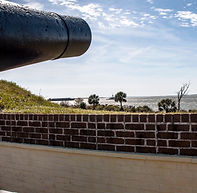
Fort Moultrie Atlantic View
This is the view of the Atlantic Ocean from Fort Moultrie, South Carolina.
Fort Moultrie was in use from 1776 until 1947, 171 years, as a coastal defense to protect Charleston, South Carolina. Originally called Fort Sullivan and built of palmetto logs, it was renamed Fort Moultrie after the battle for Sullivans Island.
Col. William Moultrie, latter to become General Moultrie, took charge of Fort Sullivan on March 2, 1776. On June 28, 1776, in the battle for the United States independence, nine British warships attcked the fort. and Sullivans Island. After a day long battle, the heavily damaged warships were driven off and had to retreat. The palmetto logs used to build the fort absorbed the British shot, which sonmetimes just bounced off. The fort was renamed Fort Moultrie after the battle.
Rebuilt in 1798 after years of neglect, and destroyed by a hurrican in 1804. Rebuilt again in 1808-1809 as a brick fortification, and was maintained and upgraded until after World Was II when it was decommissioned on August 15, 1947.
Edgar Allen Poe served here and the Seminole Inidan chief Osceola died her in 1838.
Click image for full size picture.

Ammuinition Bunker Door
A door to the main ammunition bunker in Fort Moultrie, South Carolina.
Fort Moultrie was in use from 1776 until 1947, 171 years, as a coastal defense to protect Charleston, South Carolina. Originally called Fort Sullivan and built of palmetto logs, it was renamed Fort Moultrie after the battle for Sullivans Island.
Col. William Moultrie, latter to become General Moultrie, took charge of Fort Sullivan on March 2, 1776. On June 28, 1776, in the battle for the United States independence, nine British warships attcked the fort. and Sullivans Island. After a day long battle, the heavily damaged warships were driven off and had to retreat. The palmetto logs used to build the fort absorbed the British shot, which sonmetimes just bounced off. The fort was renamed Fort Moultrie after the battle.
Rebuilt in 1798 after years of neglect, and destroyed by a hurrican in 1804. Rebuilt again in 1808-1809 as a brick fortification, and was maintained and upgraded until after World Was II when it was decommissioned on August 15, 1947.
Edgar Allen Poe served here and the Seminole Inidan chief Osceola died her in 1838.
Click image for full size picture.

Vickery's
Vickery's is a wonderful restaurant and Bar overlooking Shem Creek in Mount Pleasant, South Carolina.
The shrimping industry started at Shem Creek in Mount Pleasant, South Carolina in 1930. At its peak there were seventy trawlers working out of Shem Creek. As of 2011 only 10 trawlers remained and a few charter boats.
Today Shem Creek is lined with restaurants and bars as well as the remaining commercial boats.
Click image for full size picture.

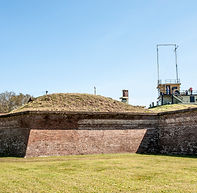
Fort Moultrie External Wall
The landside Fort Moultrie external wall on Sullivan's Island, South Carolina.
Fort Moultrie was in use from 1776 until 1947, 171 years, as a coastal defense to protect Charleston, South Carolina. Originally called Fort Sullivan and built of palmetto logs, it was renamed Fort Moultrie after the battle for Sullivans Island.
Col. William Moultrie, latter to become General Moultrie, took charge of Fort Sullivan on March 2, 1776. On June 28, 1776, in the battle for the United States independence, nine British warships attcked the fort. and Sullivans Island. After a day long battle, the heavily damaged warships were driven off and had to retreat. The palmetto logs used to build the fort absorbed the British shot, which sonmetimes just bounced off. The fort was renamed Fort Moultrie after the battle.
Rebuilt in 1798 after years of neglect, and destroyed by a hurrican in 1804. Rebuilt again in 1808-1809 as a brick fortification, and was maintained and upgraded until after World Was II when it was decommissioned on August 15, 1947.
Edgar Allen Poe served here and the Seminole Inidan chief Osceola died her in 1838.
Click image for full size picture.

